
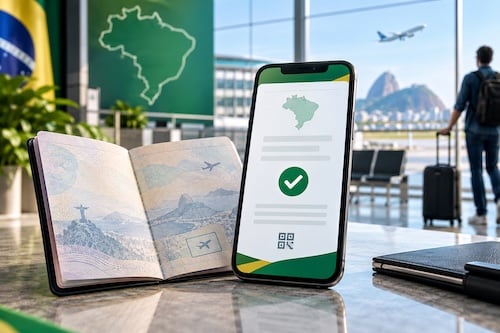
Brazil has introduced an important digital upgrade to its immigration system, allowing eligible foreign nationals to obtain temporary and work visas electronically without submitting their physical passports at a Brazilian consulate.
Effective September 1, 2026, the new procedure applies to citizens of countries that are exempt from Brazil’s visitor-visa requirement. According to immigration firm Fragomen, it covers all temporary visa categories, including employment, family reunion and digital nomad visas.
What Is Changing?
Eligible applicants can submit their visa application and supporting documents electronically through Brazil’s Integrated Consular System.
Once an application is approved, the visa is expected to be delivered to the applicant by email. This eliminates several steps that previously complicated the process, including:
- Visiting a Brazilian embassy or consulate to submit a passport
- Providing original documents in person
- Leaving a passport with the consular office during processing
- Returning to the consulate or arranging delivery to recover the passport
Travelers will generally need to print the electronic visa and carry it when entering Brazil. Temporary visa holders may also need it when completing their immigration registration after arrival.
Who Is Eligible?
The digital process applies only to nationals who do not ordinarily require a visitor visa for short stays in Brazil.
Travelers should consult the Brazilian Ministry of Foreign Affairs’ official visa-requirement chart to determine whether their nationality qualifies.
This distinction is important. The procedure does not automatically cover every foreign national applying for a Brazilian temporary visa. Applicants should confirm their eligibility with the Brazilian consular office responsible for their place of residence before beginning the process.
A list of Brazilian embassies and consulates is available through the government’s Consular Portal.
Documentation Requirements Remain in Place
Although the application and issuance process has been digitalized, Brazil has not eliminated the underlying documentation requirements.
Depending on the visa category, applicants may still need to provide:
- A completed visa application
- A copy of a valid passport
- A recent photograph
- Police clearance certificates
- Proof of payment of the applicable consular fee
- Proof of employment, family relationship or remote income
- Documents that have been legalized, apostilled or officially translated
Requirements vary according to the visa category and the consular jurisdiction handling the application. Brazil’s Ministry of Foreign Affairs provides general guidance on visas for foreign nationals, but applicants should always check the instructions published by their particular consulate.
Work-Visa Authorization Is Still Required
The new system simplifies the consular portion of the process, but it does not replace the residence-authorization procedure associated with most Brazilian work visas.
In a typical employment case, the sponsoring company in Brazil must first request authorization from the Ministry of Justice and Public Security. After that authorization is approved and forwarded to the appropriate consular post, the foreign employee can complete the electronic visa application.
Therefore, the reform should not be interpreted as permission to work in Brazil simply because a traveler is exempt from obtaining a visitor visa. Visitor status and authorization to work remain legally distinct.
Registration After Arrival Has Not Changed
Temporary visa holders who are required to register with Brazil’s Federal Police must still do so after entering the country. The new electronic system changes how the visa is issued abroad, not the immigration formalities that may apply once the traveler arrives in Brazil.
Applicants should retain a printed copy of the electronic visa and all relevant approval documents for travel and registration purposes.
A Significant Improvement for International Mobility
The reform should reduce delays, travel expenses and administrative work for professionals, employers, families and digital nomads. It also allows applicants to keep their passports during processing—particularly useful for people who travel frequently or live far from a Brazilian consulate.
No universal processing time has yet been announced, and procedures may vary while individual consular offices implement the new system. Applications already underway before September 1 may also be handled differently.
Anyone planning to apply should verify the latest requirements directly with the responsible Brazilian embassy or consulate before submitting documents or making firm travel arrangements.
For general information, visit Brazil’s official Consular Portal or read the original Fragomen immigration update.
This article is intended for general information and does not constitute legal or immigration advice.