
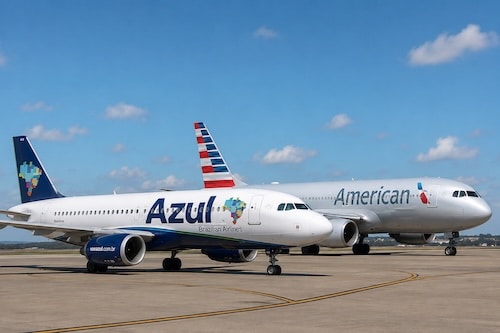
The General Superintendence of Brazil’s Administrative Council for Economic Defense, known as Cade, has recommended the unconditional approval of American Airlines’ investment in Azul Brazilian Airlines.
Under the proposed transaction, American Airlines would acquire a minority stake of approximately 8% in the Brazilian carrier.
The investment is part of Azul’s recapitalization following the completion of its financial restructuring process in the United States. American Airlines committed to investing US$100 million in Azul through the subscription of stock-purchase warrants.
Completion of the transaction required approval from Brazilian competition authorities.
Cade Finds No Significant Competition Concerns
As part of its review, Cade examined potential overlaps between Azul and American Airlines in passenger and cargo transportation between Brazil and the United States.
The analysis included routes connecting São Paulo with Miami and Orlando, as well as services between Rio de Janeiro and both Florida destinations. The authority also reviewed competition in the air-cargo market between the two countries.
According to Cade’s opinion, the transaction does not constitute a merger between the airlines, does not remove a competitor from the market and is unlikely to reduce competition or harm consumers.
The agency also noted that the market remains contested by airlines including LATAM, GOL, Copa Airlines, Avianca and Delta Air Lines.
Investment Could Strengthen Azul in Brazil
One of Cade’s main conclusions was that the American Airlines investment could improve Azul’s ability to compete in the Brazilian aviation market.
The capital injection comes as Azul rebuilds its financial position after completing a restructuring process under Chapter 11 protection in the United States.
The airline reported reducing approximately US$2.5 billion in debt and aircraft lease obligations while also raising new capital to improve liquidity.
In addition to American Airlines, United Airlines also committed US$100 million to Azul’s recapitalization. Both U.S. carriers are particularly interested in Azul’s extensive domestic network, which provides connections to more than 100 destinations across Brazil.
American Airlines Expands Its Indirect Reach in Brazil
For American Airlines, the investment provides a stronger bridge into Brazil’s domestic market.
The U.S. carrier already has a significant presence on routes between Brazil and the United States, particularly through its Miami hub. A minority stake in Azul could give American’s passengers improved access to Brazilian cities that do not have nonstop international service.
The deal could also create opportunities for deeper commercial cooperation, including expanded codeshare agreements, coordinated connections and greater integration between the TudoAzul and AAdvantage loyalty programs.
Any such developments, however, would depend on separate commercial agreements and potentially additional regulatory approvals.
Approval Could Still Be Challenged
Although Cade’s General Superintendence issued a favorable recommendation, the process must still pass through a final procedural stage.
Abra Group, the parent company of GOL and Avianca, may file an appeal, while Cade’s tribunal may also request a review of the case.
Unless an appeal or formal request for review is submitted within 15 days of the decision’s publication in Brazil’s Official Gazette, the approval will become final.
A New Chapter for Azul
Cade’s recommendation removes one of the final regulatory obstacles to American Airlines becoming an Azul shareholder.
The move places the Brazilian carrier in an unusual position, with financial backing from two major competing U.S. airlines: American Airlines and United Airlines.
Azul’s next challenge will be turning that support into sustainable growth, stronger connectivity and lasting financial stability.
For Brazil’s aviation market, the investment could mean a better-capitalized Azul with greater ability to compete in both domestic and international markets.