
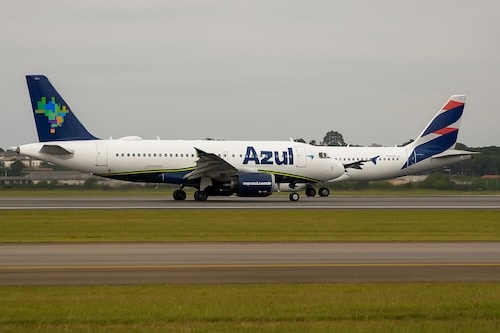
Brazil’s airline industry is facing a new kind of turbulence — not in the skies, but in the cockpit. In recent weeks, a growing number of pilots from Azul Linhas Aéreas Brasileiras have been leaving the company to join LATAM Airlines Brasil, drawn by higher salaries, improved working conditions, and greater long-term stability.
According to a report from O Estado de S. Paulo, more than 40 Azul pilots resigned in September alone, nearly four times the usual monthly average, with the vast majority migrating to LATAM. The shift highlights the growing competition for skilled flight crews in a domestic market that’s rapidly recovering from the pandemic and entering a new phase of consolidation and expansion.
The Pay Gap: LATAM Offers Up to 30% More
At the heart of the exodus is money. LATAM’s pay packages for captains and first officers are reportedly 25% to 30% higher than those offered by Azul. This difference, in an industry where training is expensive and schedules are demanding, has become impossible to ignore.
In addition to base pay, LATAM has also improved benefits such as transport, layover conditions, and schedule predictability — areas that Azul pilots have complained about in recent months, according to reports from Airway and Valor Econômico.
Azul, which has been under financial restructuring, recently negotiated salary adjustments below inflation levels and reduced certain perks, making its offer less competitive.
Fleet Compatibility Makes Switching Easier
A key factor facilitating the migration is fleet commonality. Both airlines operate Airbus A320 family aircraft, meaning pilots can transfer without undergoing an entirely new type-rating course — a process that can cost tens of thousands of dollars and take months.
LATAM’s aggressive recruitment campaign, offering over 300 open pilot positions, was perfectly timed to take advantage of that overlap. Many Azul aviators see it as an opportunity to move to a carrier perceived as more stable and globally connected.
LATAM’s Expansion and Azul’s Challenges
The timing also reflects each company’s contrasting realities.
Azul, currently navigating a court-supervised restructuring process in Brazil and under Chapter 11 protection in the U.S., has been focused on renegotiating debts with lessors and suppliers. While it has improved its balance sheet and extended maturities, the uncertainty surrounding its recovery plan has created unease among employees.
Meanwhile, LATAM Airlines Group, fresh out of its own Chapter 11 reorganization in 2023, is expanding again — particularly in Brazil, its largest market. In late September, LATAM announced the acquisition of up to 50 Embraer E195-E2 jets, enabling it to serve smaller regional airports and add up to 30 new domestic destinations.
This fleet diversification represents a direct challenge to Azul’s dominance in regional aviation — and it demands hundreds of new pilots, fueling the current hiring spree.
What This Means for Brazil’s Aviation Market
For Azul
-
The airline faces mounting retention pressure at a time when it needs operational stability to regain investor confidence.
-
With many experienced pilots leaving, Azul may have to raise salaries or offer incentives to prevent disruptions to its schedule.
-
Persistent turnover could affect training pipelines and increase costs, just as Azul seeks to reduce expenses.
For LATAM
-
The carrier is strengthening its human capital base with seasoned Brazilian aviators already certified on its main aircraft type.
-
It’s also consolidating its role as the employer of choice in Brazil’s airline sector, which could make future recruitment easier and cheaper.
-
The expanded domestic network will help LATAM capture market share, particularly on routes that were once Azul’s niche.
For the Industry and Consumers
-
The pilot migration underscores a broader reshuffling in Brazil’s post-pandemic aviation landscape, where workforce dynamics, mergers, and fleet strategies are tightly intertwined.
-
With LATAM expanding and Azul under restructuring, expect intensified competition on domestic routes — a development that could ultimately benefit passengers through better prices and connectivity.
Final Approach: Labor as the New Battleground
The wave of resignations from Azul to LATAM reveals a simple truth: in Brazil’s competitive airline market, pilots are the new strategic asset. As airlines scale up and modernize, talent retention has become as critical as route rights or aircraft deliveries.
For Azul, stabilizing its workforce will be key to restoring confidence in its turnaround story. For LATAM, the inflow of experienced crews will accelerate its growth and reinforce its position as Brazil’s largest airline.
But beneath the headlines, this is also a human story — one of professionals seeking fair compensation, predictability, and dignity in a demanding and increasingly globalized industry.